
MULTI-DAY MOROCCO TOUR
9-Day Casablanca to Sahara Desert & Essaouira Coast Tour
Every Marvels of Morocco trip is private and fully customizable. This itinerary is a starting point — we’ll shape it around your dates, pace, and interests.
A private multi-day Morocco tour from Casablanca combining Rabat, Marrakech, the Sahara Desert, and the Atlantic coast at Essaouira.
DURATION
9 Days / 8 Nights
ROUTE
Casablanca Loop (Desert & Coast)
GROUP SIZE
2-16 People
TYPE
Private Multi-Day Tour
Tour Overview
This 9-day private tour is a full route for travelers flying into Casablanca who want to experience the Sahara Desert and the Atlantic coast in one trip. It combines the capital Rabat, the energy of Marrakech, a night in the desert, and relaxed time in Essaouira, before returning to Casablanca.
Traveling by private vehicle with your own driver, this multi-day Morocco tour is one of our most complete Morocco tours from Casablanca, mixing cities, desert, and coast.
Tour Highlights
- Visit the Hassan II Mosque in Casablanca
- Explore Rabat, Morocco’s elegant capital
- Discover Marrakech, including the souks and Jemaa el-Fnaa
- Cross the High Atlas Mountains and visit Ait Ben Haddou
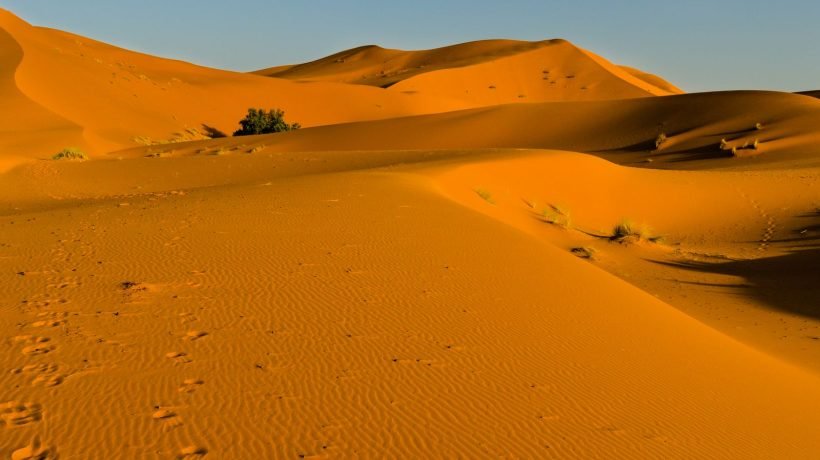
- Camel trek into the Sahara Desert dunes at Merzouga
- Two nights in a private desert camp under the stars
- Relax in Essaouira, a laid-back Atlantic port town
- Explore the Essaouira medina and its fishing harbor
Day-by-Day Itinerary
DAY 01
Day 1: Arrival in Casablanca & the Hassan II Mosque
Your driver-guide meets you at Mohammed V International Airport and transfers you into Casablanca, Morocco’s largest city and its economic capital. Unlike the walled medinas of Fes or Marrakech, Casablanca is a modern Art Deco and Moorish-influenced port city that grew rapidly in the twentieth century under French colonial planning, and its wide boulevards and white-washed buildings still carry that layered history.
The centerpiece of your first afternoon is the Hassan II Mosque, one of the largest mosques in the world and the only one in Morocco that welcomes non-Muslim visitors on a guided tour. Built on a promontory over the Atlantic Ocean and completed in 1993, the mosque features a 210-metre minaret, a retractable roof, and hand-carved cedar, marble, and zellige tilework produced by thousands of Moroccan artisans. Standing inside its vast interior, with waves visible through the glass floor panels in places, gives a first, striking introduction to the scale of Moroccan craftsmanship you will see echoed throughout the trip.
Afterward, take a short walk along the Corniche, Casablanca’s seafront promenade lined with cafés, or stroll through the old medina quarter near the port for a quieter, more local contrast to the mosque’s grandeur. In the evening, settle into your riad or hotel and enjoy a restful night before the drive to Rabat begins the tour proper the next morning.
DAY 02
Day 2: Casablanca to Rabat, then on to Marrakech
This morning you head north along the coast to Rabat, Morocco’s political capital and a UNESCO World Heritage city that blends Almohad-era monuments with French Protectorate-era urban planning. Rabat is calmer and greener than Casablanca, and it offers an excellent introduction to Morocco’s royal and Islamic history before the trip turns south toward the desert.
Your guide will take you to the Kasbah of the Udayas, a fortified twelfth-century citadel overlooking the mouth of the Bou Regreg River, with narrow blue-and-white lanes, a well-tended Andalusian garden, and sweeping views out to the Atlantic. From there you continue to the Hassan Tower, the unfinished minaret of a twelfth-century mosque intended to be the largest in the world, standing beside the Mausoleum of Mohammed V, where Morocco’s modern royal family is entombed beneath intricately carved marble and mosaic.
By early afternoon, you leave Rabat and drive south toward Marrakech, a journey of roughly three and a half hours through Morocco’s agricultural heartland. The landscape shifts from coastal plains to rolling farmland dotted with olive groves as you approach the Red City. You arrive in Marrakech in the late afternoon, with the evening free to rest or take an early stroll near your riad before two full days of exploring the city.
DAY 03
Day 3: Marrakech Guided City Tour
A full day is dedicated to Marrakech, one of Morocco’s four imperial cities and the gateway to the south. Your guide leads a walking tour through the medina, beginning at the Koutoubia Mosque, whose twelfth-century minaret has served as the architectural model for the Giralda in Seville and the Hassan Tower in Rabat, making it one of the most influential buildings in western Islamic architecture.
From there you visit the Bahia Palace, a nineteenth-century vizier’s residence with courtyard gardens, painted cedar ceilings, and dozens of interconnected rooms that reflect the private life of Morocco’s ruling elite. You will also visit the Saadian Tombs, rediscovered in 1917 after being sealed for centuries, where elaborate marble mausoleums house the remains of Saadian sultans beneath honeycombed muqarnas ceilings.
The afternoon moves into the souks, Marrakech’s dense network of covered markets where individual streets are still organized by trade, much as they have been for centuries: dyers, leatherworkers, metalsmiths, and carpet sellers each occupy their own quarter. Your guide can help you navigate the layout and, if you wish, practice the art of respectful bargaining. As evening falls, the tour naturally leads to Jemaa el-Fnaa, the main square, which transforms after dark into an open-air spectacle of food stalls, storytellers, musicians, and henna artists that has been recognized by UNESCO as a Masterpiece of the Oral and Intangible Heritage of Humanity.
DAY 04
Day 4: Marrakech to Dades Valley via the High Atlas & Ait Ben Haddou
Leaving Marrakech behind, you begin the mountain crossing that defines much of southern Morocco travel: the Tizi n’Tichka pass, which climbs to over 2,200 metres through the High Atlas Mountains. The two-lane road winds through Berber villages built from packed earth and stone, past almond and walnut orchards clinging to steep terraces, with views that stretch across ridgelines toward snow-capped peaks for much of the year.
Partway through the crossing, you stop at Ait Ben Haddou, a fortified ksar of earthen clay buildings that has stood along the historic caravan route between the Sahara and Marrakech since at least the eleventh century. A UNESCO World Heritage Site, Ait Ben Haddou has been used as a filming location for productions including Lawrence of Arabia, Gladiator, and Game of Thrones, and walking through its narrow passages and climbing to the hilltop granary at the top offers one of the most photogenic stops of the entire tour.
Continuing east, the road passes through Ouarzazate, Morocco’s film-industry hub, before entering the Dades Valley, often called the Valley of a Thousand Kasbahs for the dozens of fortified earthen structures scattered along the river below dramatic rock formations. You overnight in a kasbah-style guesthouse in the valley, surrounded by rugged red cliffs that glow deep orange at sunset.
DAY 05
Day 5: Dades to Merzouga via the Todra Gorges & the Sahara Desert
This morning, before continuing toward the desert, you detour to the Todra Gorges, a spectacular canyon where sheer rock walls rise as high as 300 metres above a narrow river bed, in places just a few metres wide. It is one of the most dramatic natural sites in Morocco and a popular spot for rock climbers from around the world; a short walk along the canyon floor gives a real sense of its scale.
From the gorges, the drive continues east through the increasingly arid landscape of the pre-Sahara, passing through date-palm oases and small desert towns until you reach Merzouga, on the edge of the Erg Chebbi dune sea. In the late afternoon, you exchange your vehicle for a camel and set off across the dunes with a local Berber guide, watching the sand shift from gold to orange to deep red as the sun sets over the Sahara.
You spend the night at a private desert camp among the dunes, sleeping in traditional Berber-style tents furnished with proper beds and bedding. Dinner is cooked over an open fire, and after the meal your camp hosts typically gather around for traditional drumming beneath a sky famous for being one of the darkest, and therefore clearest, in Morocco for stargazing — the first of two nights you will spend beneath it.
DAY 06
Day 6: A Full Day in the Sahara Desert
Rather than leaving the dunes after a single night, this itinerary allows a full day to settle into the rhythm of desert life. After a slow breakfast at camp, spend the morning with a 4×4 exploring further into the Erg Chebbi dune sea, stopping at a semi-nomadic Berber family’s home to learn how life is organized around the seasons and the availability of water in one of the most inhospitable landscapes in Morocco.
The heat of midday is best spent back at camp — read in the shade of your tent, try sandboarding down one of the taller dunes nearby, or simply take in the near-total silence that gives the Sahara its particular character.
As the light softens in the late afternoon, climb a dune for a second sunset over Erg Chebbi before returning to camp for another Berber dinner cooked over an open fire, followed by music and drumming beneath the same exceptionally dark, clear sky that made the previous night’s stargazing so memorable.
DAY 07
Day 7: Sahara Sunrise & Journey Toward Marrakech
On your final morning in the desert, many guests once more rise before dawn to climb a nearby dune and watch the sunrise over the Sahara, as the first light turns the dunes a deep rose-gold before settling into their daytime ochre. After a simple breakfast at the camp, you ride your camel back to Merzouga and reunite with your driver.
The day is largely a transit day back toward Marrakech, but it is broken up with worthwhile stops along the way, including the town of Rissani, once the capital of the Tafilalt region and the ancestral home of Morocco’s ruling Alaouite dynasty, known for its lively Sunday and Tuesday souks and traditional adobe architecture. Depending on timing, your guide may also stop at a roadside cooperative to see how local Berber communities process argan oil by hand, a product unique to southwestern Morocco.
You retrace part of the route through the Dades Valley and Ouarzazate before arriving back in Marrakech in the evening, where you have a free night to relax after two intensive days of travel, or to revisit the souks and squares of the city one more time.
DAY 08
Day 8: Marrakech to Essaouira, the Atlantic Wind City
Today the tour shifts entirely in character, trading the desert and mountains for Morocco’s Atlantic coast. The drive to Essaouira takes roughly two and a half hours through argan tree forests unique to this part of Morocco, where you may see local goats climbing into the branches to feed, a genuinely unusual sight worth a quick photo stop.
Essaouira itself is a UNESCO World Heritage fortified port city, built in its current form in the eighteenth century by the French military architect Théodore Cornut on the orders of Sultan Mohammed III, who wanted a modern harbor to trade directly with Europe. The result is a distinctive whitewashed medina with blue shutters and doors, ringed by sea-facing ramparts and cannon-lined bastions that give the town a very different visual character from anywhere else on this tour.
On arrival, your guide leads a walking tour through the compact medina, visiting the fishing port where colorful wooden boats unload the day’s catch, the Skala de la Ville ramparts made famous in films and, more recently, as a filming location for Game of Thrones, and the calm, art-gallery-lined streets that have made Essaouira a favorite of Moroccan and international artists for decades.
DAY 09
Day 9: Essaouira to Casablanca & Departure
On your final day, you depart Essaouira and drive back toward Casablanca, a journey of approximately four to five hours depending on traffic and your flight time. The route retraces the coastal argan region before rejoining the highway network into Casablanca.
Depending on your flight schedule, your guide can build in a final stop, whether a last walk along the Corniche, a coffee near the Hassan II Mosque for photos in different daylight, or simply a direct transfer to the airport if time is limited. Throughout the drive, this is a natural opportunity to ask your guide any last questions about Morocco, from practical travel tips to deeper context on the history, culture, and daily life you experienced over the past nine days.
Your driver drops you at Mohammed V International Airport in good time for your onward flight, bringing to a close a tour that covered Morocco’s capital, its most iconic imperial city, the Sahara Desert, and the Atlantic coast in a single, well-paced private itinerary.
What’s Included
- 8 nights accommodation (riads and kasbah-style guesthouses)
- 2 nights in a private Sahara Desert camp
- Private transportation in an air-conditioned vehicle
- Professional English-speaking driver-guide throughout
- Camel trek in the Erg Chebbi dunes
- Guided tours of Casablanca, Rabat, Marrakech and Essaouira
- Daily breakfast
- All accommodation taxes and fees
What’s Not Included
- International flights
- Lunches and dinners (except at the desert camp)
- Entrance fees to monuments and museums
- Travel insurance
- Personal expenses and souvenirs
- Tips for your driver-guide and camp staff
Good to Know Before You Go
- This tour runs privately, so your departure date and daily pace can be adjusted to suit your preferences.
- Comfortable walking shoes are recommended for the medinas of Marrakech and Essaouira, both of which have uneven cobbled streets.
- Desert nights can be cold, even in summer, so pack a warm layer for the evening camel trek and campfire.
- For more background on the route, see our Morocco Desert Tours and browse other multi-day Morocco tours.
- This itinerary can be combined with a Marrakech-only or Fes-only extension on request.
Frequently Asked Questions
START PLANNING
Ready to Explore Morocco’s Desert and Coast?
Reach out to our team to check availability, customize the itinerary, and start planning your 9-day private Morocco tour from Casablanca.
What Our Travelers Say
“He accompanied us throughout the tour, telling us many anecdotes about each place and many curiosities of the place, making us live a truly authentic experience.”
“Our driver, Mohamed was simply the best! He was exceptionally kind, professional, and polite, not to mention a safe and highly skilled driver — just an all-around wonderful person.”