
MULTI-DAY MOROCCO TOUR
10 Days Complete Morocco Tour
Every Marvels of Morocco trip is private and fully customizable. This itinerary is a starting point — we’ll shape it around your dates, pace, and interests.
A private 10-day Morocco itinerary covering Marrakech, the High Atlas, the Sahara Desert, Fes, Chefchaouen, Rabat and Casablanca in one complete route.
DURATION
10 Days / 9 Nights
ROUTE
Marrakech to Casablanca (Complete Morocco Loop)
GROUP SIZE
2-16 People
TYPE
Private Multi-Day Tour
Tour Overview
Designed for travelers who want to see Morocco in full, this 10-day private tour links the country’s desert landscapes, imperial cities, and northern highlights into a single, well-paced itinerary. It begins in Marrakech, crosses the High Atlas Mountains to the Sahara Desert, continues north to Fes, detours to the blue-washed town of Chefchaouen, and finishes along the Atlantic coast in Rabat and Casablanca.
Traveling in a private vehicle with your own driver-guide, this is one of our most comprehensive multi-day Morocco tours, pairing our Morocco Desert Tours route with the imperial cities and the north in a single Morocco itinerary.
Tour Highlights
- Explore Marrakech’s medina, palaces and souks
- Cross the High Atlas Mountains via the Tizi n’Tichka pass
- Visit the UNESCO-listed kasbah of Ait Ben Haddou
- Camel trek and two nights in a desert camp in the Sahara at Merzouga
- Walk through the Todra Gorges canyon
- Discover Fes el Bali, the world’s largest car-free urban area
- Visit the Roman ruins of Volubilis and imperial city of Meknes
- Wander the blue streets of Chefchaouen
- See the Hassan II Mosque and Kasbah of the Udayas
Day-by-Day Itinerary
DAY 01
Day 1: Arrival in Marrakech
Your driver-guide welcomes you at Marrakech Menara Airport and transfers you to your riad in the medina, Marrakech’s historic walled old town. Founded in 1070 by the Almoravid dynasty, Marrakech has served for nearly a thousand years as a crossroads between the Sahara, the Atlas Mountains, and the Mediterranean world, and its ochre-red ramparts still enclose one of the most atmospheric old cities in North Africa.
Depending on your arrival time, your first afternoon can be as active or as relaxed as you like. Many travelers choose a gentle introduction: a stroll to Jemaa el-Fnaa, the main square, to get a first look at its snake charmers, orange-juice stalls, and henna artists before the evening crowds arrive, followed by a quiet dinner on a rooftop terrace overlooking the Koutoubia Mosque’s minaret lit up against the night sky.
This first evening is a good opportunity to rest after your flight and settle into the rhythm of Moroccan travel, with a full guided day in Marrakech to follow tomorrow and nine more days of desert, mountains, and imperial cities ahead.
DAY 02
Day 2: Marrakech Guided City Tour
A full day is dedicated to exploring Marrakech with your guide, starting at the Koutoubia Mosque, whose twelfth-century minaret became the architectural template for the Giralda in Seville and the Hassan Tower in Rabat, making it one of the most influential structures in western Islamic architecture. From there you continue to the Bahia Palace, a sprawling nineteenth-century residence built for a powerful vizier, where painted cedar ceilings and tiled courtyards reflect the domestic life of Morocco’s ruling class.
You will also visit the Saadian Tombs, a royal necropolis rediscovered only in 1917 after being sealed off for centuries, its marble mausoleums and honeycombed muqarnas ceilings ranking among the finest surviving examples of Saadian-era craftsmanship. For a contrast in eras, many itineraries also include the Majorelle Garden, a striking cobalt-blue garden estate restored by fashion designer Yves Saint Laurent, filled with cacti, bamboo groves, and a small Berber museum.
The afternoon leads into the souks, Marrakech’s historic market quarters, still organized by trade much as they have been for centuries, before finishing at Jemaa el-Fnaa as it transforms into an open-air theater of food stalls, musicians, and storytellers each evening, a UNESCO-recognized tradition unlike anything else in Morocco.
DAY 03
Day 3: Marrakech to Ait Ben Haddou & the Dades Valley
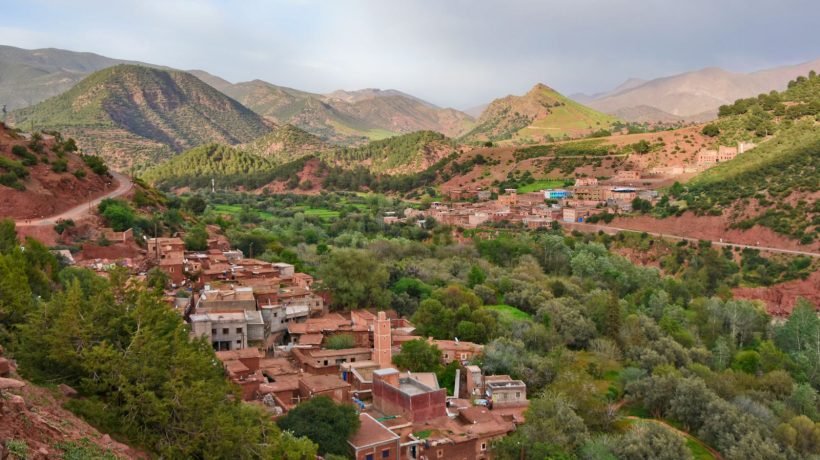
Today you leave Marrakech and begin the mountain crossing that defines much of southern Morocco: the Tizi n’Tichka pass, climbing to over 2,200 metres through the High Atlas. The road winds past Berber villages built from packed earth and stone, terraced almond and walnut orchards, and viewpoints that stretch across ridgelines often capped with snow well into spring.
Midway through the crossing you stop at Ait Ben Haddou, a fortified ksar that has guarded the caravan route between the Sahara and Marrakech since at least the eleventh century. Its UNESCO World Heritage status and cinematic silhouette have made it a filming location for Lawrence of Arabia, Gladiator, and Game of Thrones, and climbing to its hilltop granary rewards you with sweeping desert-edge views.
Continuing east through Ouarzazate, Morocco’s film-industry hub, you enter the Dades Valley, often called the Valley of a Thousand Kasbahs for its dozens of fortified earthen structures set against dramatic red rock formations. You overnight in a kasbah-style guesthouse in the valley, where the cliffs glow a deep orange as the sun sets.
DAY 04
Day 4: Dades to Merzouga via Todra Gorges & the Sahara Desert
Before continuing east, you detour into the Todra Gorges, where sheer limestone walls rise up to 300 metres above a narrow river bed, in places barely wide enough for the road itself. It is one of Morocco’s most dramatic natural sites and a magnet for rock climbers worldwide; a short walk along the canyon floor conveys the scale better than any photograph.
From the gorges, the road continues through the increasingly arid pre-Sahara landscape, passing date-palm oases and small desert towns until you reach Merzouga, on the edge of the Erg Chebbi dune sea. In the late afternoon you trade your vehicle for a camel and set off across the dunes with a local Berber guide, watching the sand shift from gold to orange to deep crimson as the sun sets.
You spend the night at a private desert camp among the dunes, in traditional Berber-style tents furnished with proper beds. Dinner is cooked over an open fire, and camp staff typically gather afterward for traditional drumming beneath one of the darkest, clearest night skies in Morocco — the first of two nights under it.
DAY 05
Day 5: A Full Day in the Sahara Desert
Rather than moving on after a single night, this itinerary builds in a full day to settle into the rhythm of the dunes. After a relaxed breakfast at camp, head out by 4×4 to visit a semi-nomadic Berber family living at the desert’s edge, and learn how daily life is shaped around water and the seasons in one of Morocco’s most extreme landscapes.
Spend the warmest hours of the afternoon back at camp — resting in the shade, trying your hand at sandboarding on the nearby dunes, or simply taking in the silence that makes the Sahara so different from anywhere else on this trip.
As the light turns golden in the late afternoon, climb a dune for a second sunset over Erg Chebbi before returning to camp for another Berber dinner and an evening of music around the fire, under the same exceptionally clear sky for stargazing.
DAY 06
Day 6: Sahara Sunrise, Ziz Valley & the Road to Fes
On your final morning in the desert, many guests once more rise before dawn to climb a nearby dune and watch the sunrise over the Sahara, as the first light turns the dunes from deep rose to gold. After breakfast at camp, you ride back to Merzouga and reunite with your driver for a long but rewarding day north toward Fes.
The route follows the Ziz Valley, one of Morocco’s most striking natural corridors, where a ribbon of date palm oasis winds through an otherwise stark, rocky landscape below the Ziz Gorges. You pass through the town of Er-Rachidia and climb through the Middle Atlas via Midelt, a region known for its apple orchards and, at higher elevations, its cedar forests.
By late afternoon or early evening you arrive in Fes, Morocco’s spiritual and cultural capital, and settle into a riad within or near the medina walls, with a full day of guided exploration to follow tomorrow.
DAY 07
Day 7: Fes Guided City Tour
Fes el Bali, founded in the ninth century, is considered the best-preserved medieval city in the Arab world and remains the largest car-free urban area on earth, its estimated 9,000 alleyways navigable only on foot or by donkey. Your guide is essential here, leading you through this labyrinth to sites that would be nearly impossible to find alone.
Highlights typically include the Al-Qarawiyyin Mosque and University, founded in 859 and recognized by UNESCO and Guinness World Records as the oldest continuously operating institution of higher learning in the world, along with the ornate Bou Inania Madrasa, a fourteenth-century Quranic school renowned for its cedar carving, zellige tilework, and carved stucco.
No visit to Fes is complete without the Chouara Tannery, where leather has been dyed by hand in stone vats since the eleventh century using techniques that remain largely unchanged; viewing platforms at nearby leather shops offer the classic overhead view of the tannery’s colorful pits. You will also pass through the souks, where metalworkers, weavers, and woodcarvers each occupy their own historic quarter.
DAY 08
Day 8: Fes to Chefchaouen — via Meknes & Volubilis
Leaving Fes, you head toward Meknes, the smallest of Morocco’s four imperial cities, built up dramatically in the seventeenth century by Sultan Moulay Ismail, who envisioned it as Morocco’s answer to Versailles. You visit the monumental Bab Mansour gate, considered one of the finest examples of imperial Moroccan gateway architecture, along with the sultan’s vast former granaries and stables.
Just outside Meknes lie the Roman ruins of Volubilis, once the westernmost outpost of the Roman Empire in Africa, with remarkably preserved mosaics still covering the floors of what were once wealthy merchants’ villas.
From Volubilis, the road climbs into the Rif Mountains toward Chefchaouen, Morocco’s famous blue-washed mountain town, founded in 1471 as a small Andalusian and Rif Berber fortress town. Arriving in the late afternoon, your guide leads you through the compact medina, past the Kasbah and its small ethnographic museum, the main square of Plaza Uta el-Hammam, and the many artisan shops selling wool textiles and woven goods. A short walk up toward the Spanish Mosque on a hillside above town rewards you with sweeping views over the blue rooftops, particularly beautiful at sunset.
DAY 09
Day 9: Chefchaouen to Rabat & Casablanca
Leaving the mountains behind, you descend toward the Atlantic coast, arriving first in Rabat, Morocco’s political capital and a UNESCO World Heritage city. Your guide takes you to the Kasbah of the Udayas, a fortified twelfth-century citadel overlooking the mouth of the Bou Regreg River, with narrow blue-and-white lanes and a peaceful Andalusian garden, followed by the Hassan Tower and the Mausoleum of Mohammed V, where Morocco’s modern royal family is entombed beneath ornately carved marble.
From Rabat, it is a short drive south to Casablanca, Morocco’s largest city and economic capital, known for its Art Deco architecture and modern, cosmopolitan character quite different from the historic medinas visited earlier in the trip.
Time permitting, you may visit the Hassan II Mosque this evening or save it for the following morning; either way, you settle into your final hotel with one more day of touring ahead before your departure.
DAY 10
Day 10: Casablanca City Tour & Departure
On your final day, you visit the Hassan II Mosque, one of the largest mosques in the world and the only one in Morocco open to non-Muslim visitors on a guided tour. Built on a promontory over the Atlantic and completed in 1993, it features a 210-metre minaret, a retractable roof, and hand-carved cedar, marble, and zellige tilework produced by thousands of Moroccan artisans, a fitting final landmark after ten days spent immersed in the country’s craftsmanship.
Depending on your flight time, your guide can also walk you along the Corniche, Casablanca’s seafront promenade, or through the old medina near the port for a final, quieter contrast to the grand mosque. This is a natural moment to reflect on the full arc of the journey, from the souks of Marrakech and the dunes of the Sahara to the medieval alleys of Fes and the blue streets of Chefchaouen.
Your driver transfers you to Mohammed V International Airport in good time for your onward flight, concluding a complete, ten-day journey through Morocco’s deserts, mountains, imperial cities, and coast.
What’s Included
- 10 nights accommodation (riads and kasbah-style guesthouses)
- 2 nights in a private Sahara Desert camp
- Private transportation in an air-conditioned vehicle
- Professional English-speaking driver-guide throughout
- Camel trek in the Erg Chebbi dunes
- Guided tours of Marrakech, Fes, Chefchaouen, Rabat and Casablanca
- Entrance to Volubilis archaeological site
- Daily breakfast
- All accommodation taxes and fees
What’s Not Included
- International flights
- Lunches and dinners (except at the desert camp)
- Entrance fees to monuments not listed above
- Travel insurance
- Personal expenses and souvenirs
- Tips for your driver-guide and camp staff
Good to Know Before You Go
- This is a private tour, so your start date, pace, and overnight stops can be tailored to your preferences.
- Comfortable walking shoes are essential for the medinas of Marrakech, Fes and Chefchaouen, all of which have uneven, hilly, cobbled streets.
- Desert nights can be cold even in summer, so pack a warm layer for the evening camel trek and campfire at the Sahara camp.
- For more on the route, see our Morocco Desert Tours and other multi-day Morocco tours.
- This itinerary can be shortened, extended, or combined with a coastal stop in Essaouira on request.
Frequently Asked Questions
START PLANNING
Ready to See the Complete Morocco?
Get in touch with our team to check availability, customize your route, and start planning your 10-day complete private tour of Morocco.
What Our Travelers Say
“He accompanied us throughout the tour, telling us many anecdotes about each place and many curiosities of the place, making us live a truly authentic experience.”
“Our driver, Mohamed was simply the best! He was exceptionally kind, professional, and polite, not to mention a safe and highly skilled driver — just an all-around wonderful person.”