MOROCCO TRAVEL GUIDE
Morocco Travel Guide
Everything you need to plan a first trip to Morocco — regions, when to go, visas and money, getting around, culture and etiquette, and where to find the detailed guides for each part of your route.
A Country Bigger and More Varied Than Most Expect
Morocco surprises most first-time visitors with how much genuine variety it packs into one country. In a single well-planned trip you can walk through a UNESCO-listed medina, cross a genuine mountain range, sleep in the Sahara Desert, and finish on an Atlantic surf beach, all without ever leaving Morocco’s borders. That range is exactly why it has become one of the most popular travel destinations for people who want a trip that feels like several countries in one, without the logistics of actually crossing borders.
This guide is the starting point for planning that trip. It covers the practical basics — regions, timing, money, getting around, and culture — and links out to our more detailed guides on each city, region, and topic as you plan your own route.
Morocco's Regions at a Glance
The Imperial Cities
Marrakech, Fes, Meknes, and Rabat, Morocco’s historic former capitals, are where most itineraries spend their city time. Each has a distinct character: Marrakech intense and colorful, Fes deeply traditional and labyrinthine, Rabat calmer and more modern. See our Marrakech travel guide for a full breakdown of the country’s most-visited city.
The Sahara Desert
The Erg Chebbi dunes near Merzouga are the most accessible and most-visited part of the Sahara from Marrakech or Fes, and a desert camp night is the highlight of most Morocco itineraries. See our Morocco desert tours for route options.
The Atlas Mountains
The High Atlas separates Marrakech from the desert routes south, and offers genuinely excellent trekking, Berber villages, and mountain scenery, whether as a day trip from Marrakech or a multi-day trek.
The Atlantic Coast
Essaouira and Agadir represent Morocco’s more relaxed, breezier side, good for balancing out the intensity of the medinas and the heat of the desert. Read more in our Essaouira guide.
Chefchaouen & the North
The blue-washed mountain town of Chefchaouen and the northern cities of Tangier and Tetouan offer a quieter, cooler contrast to the south, closer to Spain than to the Sahara, and a natural addition to a longer, north-to-south route.
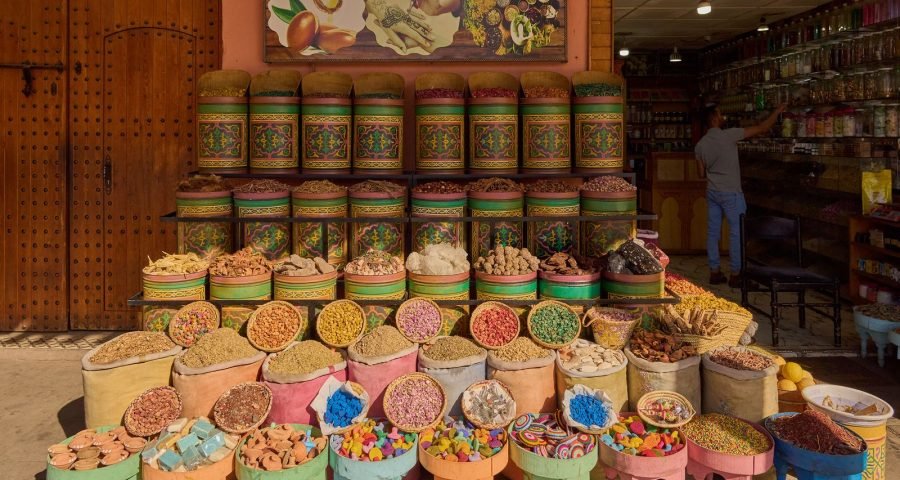
Spice markets are one of the small daily pleasures of traveling Morocco.
When to Go
Spring (March-May) and autumn (September-November) offer the most comfortable weather across the widest range of regions, from the desert to the mountains to the imperial cities. Summer is intensely hot inland but excellent on the coast, and winter is mild in the cities but genuinely cold at night in the desert and mountains. See our full best time to visit Morocco guide for a complete month-by-month breakdown.
Getting to Morocco & Visas
Morocco is well-connected by air, with direct flights from most major European cities and growing connections from North America. Marrakech, Casablanca, Fes, and Tangier all have international airports, with Marrakech and Casablanca the most common entry points for a first trip. Citizens of the US, UK, EU, Canada, and Australia, among many others, can enter Morocco visa-free for tourism stays of up to 90 days, though it is worth checking current requirements for your specific nationality before booking.
Getting Around Morocco
Morocco offers trains between major cities, inexpensive long-distance buses, shared grand taxis, and self-drive rental cars, but the reality is that none of these reach the desert, mountains, and smaller villages that make up the best parts of most itineraries, and road conditions and driving styles can be genuinely challenging for visitors unfamiliar with them. For this reason, nearly every itinerary we build is based around a private driver and guide, which removes the biggest logistics and safety headache of an independent Morocco trip and lets you cover far more ground comfortably in the time you have.
Money & Costs
The Moroccan dirham (MAD) is a closed currency, meaning it cannot be bought or sold outside Morocco, so plan to withdraw cash from ATMs after arrival (widely available in cities) or exchange money at the airport or in town. Cards are accepted at hotels, larger restaurants, and shops in tourist areas, but cash is still essential for souks, taxis, small riads, and rural areas. Morocco remains good value by European or North American standards, particularly for food, transport, and guided experiences.
Language
Arabic (Darija, the Moroccan dialect) and Amazigh (Berber) are the country’s native languages, with French widely spoken as a second language, a legacy of the colonial period, especially in business and education. English is increasingly common in tourist areas, hotels, and among younger Moroccans, but is not universal, particularly outside major cities. A private guide bridges this gap easily, and even a few basic French or Arabic phrases go a long way with locals.
Culture & Etiquette
Morocco is a Muslim country with a strong culture of hospitality, and a little awareness goes a long way. Dress modestly in public (shoulders and knees covered), expect that most working mosques are closed to non-Muslim visitors, and be respectful around prayer times and, if your trip overlaps with it, Ramadan. Bargaining in souks is normal and expected, not rude. Tipping for guides, drivers, and restaurant staff is customary. None of this is complicated, but knowing it in advance makes the first few days noticeably smoother.
Where to Go Next
Once you have the basics, these are the guides and tour pages most travelers use to build their route.
- Morocco Desert Tours — Sahara routes from Marrakech, Fes, and beyond
- Multi-Day Morocco Tours — full country itineraries combining cities, mountains, and desert
- Marrakech Travel Guide — where most trips begin
- Is Morocco Safe for Tourists? — an honest safety guide
- Solo Travel in Morocco — a complete guide for solo and solo female travelers
- Honeymoon & Romantic Morocco — private trips designed for two
How Much Time You Need, by Trip Style
A short desert escape (3-5 days): Best if Morocco is a stopover or add-on to a wider Europe trip. Focuses on Marrakech and a Sahara Desert camp, usually via Ait Ben Haddou and the Atlas Mountains, without trying to cover the whole country.
The classic highlights route (7-10 days): The most-booked length, and the one we’d recommend for most first-time visitors. Combines Marrakech, the Atlas Mountains, the Sahara Desert, and usually one more stop — Fes, Chefchaouen, or the coast — at a comfortable, unrushed pace.
The full country route (12-16 days): For travelers who want real depth rather than a highlights reel: imperial cities, the north, the desert, the mountains, and the coast, woven into one continuous private journey.
We cover sample day-by-day routes for each of these lengths in more detail in our dedicated Morocco itinerary guides, or you can simply tell us how many days you have and we’ll build a route around it.
Frequently Asked Questions
7 to 10 days is enough to combine Marrakech, the Atlas Mountains, and the Sahara Desert comfortably. Two weeks or more allows you to add the imperial cities, the north, and the coast.
Yes. See our full Morocco safety guide for a detailed, honest answer.
A private driver is the most efficient and comfortable option for most itineraries, since it reaches the desert and mountains that trains and buses do not, without the challenges of self-driving unfamiliar roads.
Citizens of the US, UK, EU, Canada, Australia, and many other countries can enter visa-free for tourism stays up to 90 days. Check current requirements for your specific nationality before booking.
Most first-time visitors build their trip around Marrakech, a Sahara Desert camp, and the Atlas Mountains, the combination that captures Morocco’s range in a single, well-paced route.
Morocco offers good value by European or North American standards, particularly for food, transport, and guided experiences, making a genuinely comfortable private trip achievable on a moderate budget.
PLAN YOUR TRIP
Ready to Plan Your Morocco Trip?
Tell us your dates, interests, and travel style, and our local team will design a private itinerary built entirely around you.