
SAHARA DESERT
Sahara Desert Temperature Guide: Merzouga Weather Month by Month
How hot the Sahara really gets by day, how cold it drops at night, and which months actually make sense for your trip — with real month-by-month numbers, not just “hot days, cold nights.”
Why Sahara Nights Are So Much Colder Than the Days
The short version: sand and dry air don’t hold onto heat. Water is what keeps temperatures stable overnight almost everywhere else you’ve traveled — humid air, damp soil, and vegetation all act like a thermal battery, absorbing heat through the day and releasing it slowly after dark. The Sahara around Merzouga has essentially none of that.
Erg Chebbi’s sand and the surrounding hammada (stony desert) heat up fast under direct sun and radiate that heat straight back into the sky the moment the sun drops, with almost nothing in the air to trap it. Add in the elevation — Merzouga sits at roughly 780 metres (2,560 feet), high enough that the air itself is thinner and cools faster than it would at sea level — and you get a genuinely dramatic day-to-night swing on a near-nightly basis, not just an occasional cold snap. It’s also why the desert cools fast: where a city loses its daytime heat gradually over a few hours after sunset, a desert camp can feel 10°C colder within 45 minutes of the sun going down.
Spring & Autumn — The Best Months to Visit
March to May, and again September to November, are the months most desert-tour operators — us included — point travelers toward. Day highs sit in a genuinely comfortable 24–34°C (75–93°F) range, camel treks at sunset don’t feel punishing, and the night-time drop, while still real, isn’t extreme enough to make a desert camp uncomfortable with a reasonable layer or two.
These shoulder-season weeks also tend to bring the clearest skies of the year for stargazing, since they sit between the hazier heat of summer and the occasional winter cloud cover. May and September run slightly warmer than the core of spring and autumn, trading a few degrees for noticeably thinner crowds at the dunes.
Winter in the Sahara (December–February)
Winter is the quiet-season trade-off. Days are mild and pleasant — typically 19–21°C (66–70°F) — but this is when the night-time swing bites hardest in relative terms. A 6°C night after a warm afternoon catches people off guard specifically because the daytime warmth doesn’t prepare you for it.
If you’re visiting in winter, the desert camp night is genuinely cold, not “brisk,” and worth packing for properly. In exchange, you get clear skies, the thinnest crowds of the year, and some of the sharpest stargazing conditions the Sahara offers.
Summer in the Sahara (June–August)
This is the one stretch worth thinking carefully about, not avoiding outright. Daytime highs regularly exceed 40°C (104°F), and a midday camel trek or long drive across open desert in that heat is genuinely demanding, even for travelers used to hot climates.
It isn’t unsafe with sensible precautions — shaded rest during the hottest hours, serious hydration, early or late excursions — but it’s a different kind of trip than a spring or autumn visit. For how desert timing fits the rest of the country, see our Best Time to Visit Morocco guide.
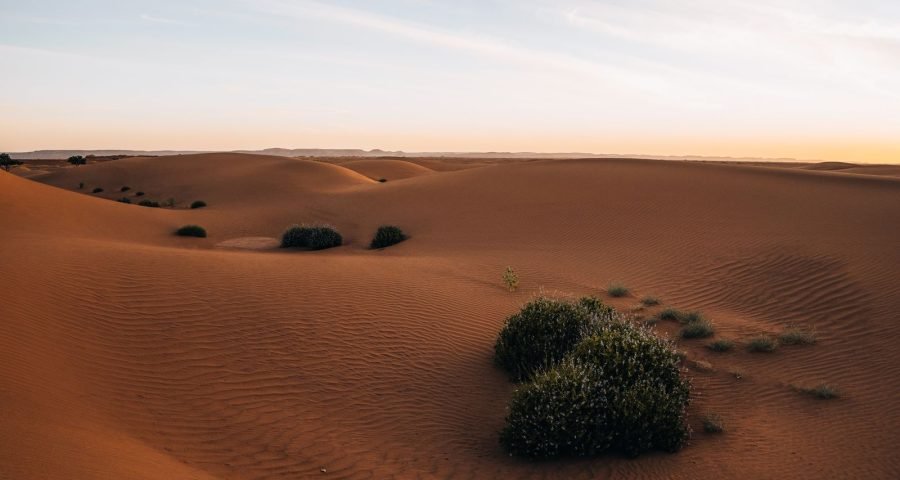
43°C / 109°F — the average July daytime high in Merzouga. Even in January it still climbs to 19°C / 66°F by early afternoon.
What to Wear in the Sahara Desert
Layers, Not One Heavy Coat
A lightweight fleece or wool mid-layer under a windproof outer layer beats a single bulky jacket — you’ll be adding and removing layers several times between afternoon arrival and the coldest pre-dawn hour, and something you can pack down small works better than a padded coat you’re either wearing or awkwardly carrying all trek.
A Hat for Both Ends of the Day
A wide-brimmed sun hat for the ride in, and a warm beanie or headscarf for the evening around the fire — desert nights lose heat through your head fast once the wind picks up.
Loose, Breathable Layers for Daytime
Even in summer, counterintuitively, covering up in light, breathable fabric (linen or technical hiking wear, not tight synthetic) keeps you cooler in direct desert sun than bare skin does, and protects against sunburn on a genuinely exposed camel trek.
Closed Shoes and Warm Socks
Closed shoes you don’t mind filling with sand for the dunes themselves, plus a separate pair of thick socks for the evening — sandals are fine back at camp, not on the trek.
A Buff or Light Scarf
Wind-blown sand is a real and common annoyance on camel treks, not just an aesthetic detail — something you can pull over your nose and mouth makes a genuine difference.
This covers desert-specific layering only. For a complete list covering the rest of a Morocco trip, see our full Morocco packing list.
Sahara Desert Temperature by Month
Daytime highs are drawn from published Merzouga climate averages and are consistent across sources. Night lows are hard-sourced for January and July only; the other months are reasoned estimates using the same ~13–14°C swing observed at those two verified points — see the note below the list.
- January — 19°C / 66°F day — 6°C / 43°F night (swing ~13°C / 23°F)
- February — 21°C / 70°F day — ~7°C / 45°F night (swing ~14°C / 25°F)
- March — 26°C / 79°F day — ~12°C / 54°F night (swing ~14°C / 25°F)
- April — 30°C / 86°F day — ~16°C / 61°F night (swing ~14°C / 25°F)
- May — 34°C / 93°F day — ~20°C / 68°F night (swing ~14°C / 25°F)
- June — 39°C / 102°F day — ~26°C / 79°F night (swing ~13°C / 23°F)
- July — 43°C / 109°F day — 29°C / 84°F night (swing 14°C / 25°F)
- August — 42°C / 108°F day — ~29°C / 84°F night (swing ~13°C / 23°F)
- September — 37°C / 99°F day — ~23°C / 73°F night (swing ~14°C / 25°F)
- October — 30°C / 86°F day — ~16°C / 61°F night (swing ~14°C / 25°F)
- November — 24°C / 75°F day — ~10°C / 50°F night (swing ~14°C / 25°F)
- December — 20°C / 68°F day — ~6°C / 43°F night (swing ~14°C / 25°F)
Where this data comes from: full month-by-month maximum temperatures for Merzouga are publicly published and consistent across climate sources. Minimum (night) temperatures are only published in complete form for January and July (~6°C and ~29°C); the other months above are calculated using that same ~13–14°C day/night swing rather than invented precise figures. Treat the exact night-low degree for any single month as a close estimate — the pattern and scale of the swing are what matter for planning.
Sahara Desert Travel Tips
- Desert camps provide proper bedding, not just a rug on the sand — a well-run camp accounts for the overnight cold with real blankets and appropriate tent setups.
- Sunrise is worth the early alarm, in any season. Climbing a nearby dune before first light to watch the sand shift from deep rose to gold is one of the best moments of a Sahara trip — and also the coldest hour of the whole 24, so your warmest layer earns its space in the bag right then.
- Rain is rare, but not impossible. The Sahara is one of the driest places on Earth, but a light rain shell takes up no space and covers the rare exception, particularly in the shoulder-season months.
- Phone signal is patchy to nonexistent at the dunes themselves, even though nearby Merzouga town has decent coverage — worth telling anyone expecting to hear from you that a night or two of silence is normal.
- The stargazing genuinely lives up to the reputation, especially outside a bright moon phase — this is one of the few places most travelers will ever see the Milky Way with the naked eye, a direct result of the same dry, particle-free air that makes the nights so cold.
Related on Marvels of Morocco: Sahara Desert Travel Guide · A Night in the Sahara Desert · Morocco Packing List · 3-Day Sahara Desert Tour from Marrakech · Morocco Desert Tours
Frequently Asked Questions
START PLANNING
Ready to Experience the Sahara Yourself?
Tell us your travel dates, and we’ll build a private itinerary around a proper desert camp night — timed for the weather you actually want.